Pages

.

Showing posts with label Michael's Dogs. Show all posts

Ask the Dog Trainer: Dealing with Fear of Larger Dogs

by Carrie Boyko, CEB

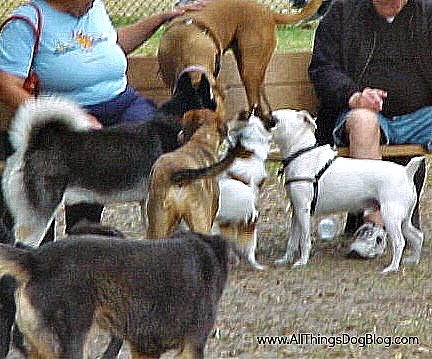
Oliver (in the middle) Joins the Big Dogs
at the Park for a Group Greeting
Dear Michael,  

I have a toy poodle that is about 7 years old. She is prissy and fearful of bigger dogs. Our neighborhood is like dog central. Mostly larger dogs but a few small ones like Chihuahuas and a Boston Terrier, plus a few crosses or rescued mutts. When I walk Muffin she is always interested in visiting other small dogs. She’s not playful but she does sniff and sort of say hello in a doggy way. Sometimes she will even stop to see a medium-sized dog like one cocker that lives around the corner. But when we see a bigger dog she will snap and growl if we get too close. I have to avoid these dogs and their owners so that Muffin doesn’t get herself into trouble. I don’t want her to get hurt. Is there a way to help her understand when a larger dog is friendly and ok to say hello to? I don’t know how to help her with this. Any tips you have would be appreciated. 

Thank you, Janet
-----------------------------------------------------------------------------------
 Dear Janet,

My heart really goes out to your little poodle. Life is complicated, so full of unknowns. I can really empathize. It’s hard to know who is safe and who is a threat. Why is he looking at me like that? Is she up to no good? Can I trust that one? While our brains are asking and processing all these questions, our emotions (think gut level) are sorting through memories and trying to fill in gaps where memories are lacking. We need to know how to handle every potential social interaction, and antisocial threat for that matter, and we sometimes only have seconds to figure it all out. It’s hard. And we are humans, supposedly the smartest animals on the planet.

Now scale all that down to your prissy little poodle (we really shouldn’t call her that, it’s not nice). But seriously, what’s a dog to think? She’s little. The big dogs, they’re really big (could be 5-10 time her size). And, who knows how the big dogs roll on any given day. One wrong choice can be fatal. For real. Better to be safe than sorry, right? Maybe that’s what she’s thinking.

But no one wants to live in fear. We can all agree on that. And you want to help, which is nice. And I want to help you, too. So, let’s sort this out.

Have your dog’s back. If you needed help with a tough situation, what would you want. An advocate maybe? Someone looking out for your best interests? A coach, perhaps? Exactly. Having your dog’s back includes two things. 1) Teaching her what do to at any given moment. I literally like to teach my dogs to look to me for instructions (like a friend asks for advice) when they are unsure of a situation. Don’t bite, don’t bark, check in with me. As you progress you can teach more advanced skills, like how to interact, sniff and otherwise greet dogs on a loose leash. The second part of having your dog’s back 2) Protect her from situations she’s not ready to handle yet. We humans are always in such a hurry. Hurry up prissy (seriously, no name calling) and get over it already. Well, let me tell you, that doesn’t work. If your dog looks unsure, steer her away from the big guys and gals. There’s no shame in that. Every growl-snap blow-up solidifies her fear and sets back your training considerably. Take your time. Work smart.

Teach her that she is safe. If you use reinforcement-based training to teach her how to handle herself when big dogs are around (look to you for instructions etc.), you can actually help her learn that she’s not in any real danger. A good qualified dog behavior consultant who understands desensitization and counter conditioning can help with this. All your dog needs to know is that you will protect her and that seeing big dogs means good things (not bad) are about to happen. Specifically, she’s going to get treats for following your simple instructions. Every encounter with a big dog comes with structure as well as your praise and treats. It’s subtle, but this teaches your dog that she’s safe (not in any real danger) when big dogs are around.

Support good choices. Let’s watch how this plays out. When you notice your dog making good behavior choices (especially when she sees big dogs), be there to support those choices. Praise her. Treat her. Smile and let her know she’s being a brave girl. Here are some good dog choices to be on the lookout for:

  • Checking in with you on her own (not barking)
  • Steering clear of the dog on her own (as you’ve shown her do to many times before)
  • Approaching the other dog slowly on her own (don’t force this)
  • Allowing the dog to sniff while she’s calm on a loose leash (your behavior coach can help you get to this level).
Oliver's Ears Tell the Story:
He's on High Alert Here
How do you measure success? At first, I look for lower intensity reactions from the dog, like less barking or choosing to walk away rather than snap. I also look for quicker recovery times from the dog, responding faster to your directions if she gets in past her comfort level and barks or snaps. In the long run, we aim for calm social interactions. There’s a lot we can do and there is help available to you. When all is said and done, though, it’s up to the dog. She may end up being more comfortable hanging with the little dogs. Maybe that’s just how she rolls.

© used with permission from Robyn Arouty Photography

Michael Baugh CDBC CPDT-KSA works with families with fearful and aggressive dogs in Houston, TX. He’s a regular contributor to allthingsdogblog.com, Chron.com and his own blog michaelbaugh.com


Follow Me on Pinterest instagram
Michael's advice does not replace an actual consultation with a qualified trainer.
reade more... Résuméabuiyad
Ask the Dog Trainer About House Training

by Michael Baugh CDBC CPDT-KSA
© AllThingsDogBlog.com
Good Boy, Tanner!
You Don't Need the Bells

Here’s what I know about potty training dogs, and even young puppies. It can be as simple as we want to make it. It can also be as complicated as we want to make it.


That may seem a bit obvious, but think on that a minute (I’ll wait).

We worry an awful lot about our dog’s behavior when it comes to potty training. He won’t let us know when he wants to go out. He does his business outside when he wants to. Or worse still, he poops and pees in the house when he’s mad at us. My advice: let’s focus more on the behavior we can actually control – our own.

Successful potty training has everything to do with our actions.

  • Let’s show up and notice when the dog poops and pees outside (and reinforce that behavior).
  • Let’s supervise our dog carefully inside so he doesn’t “go” in the wrong place. And let’s set up a safe and comfortable area for him to stay in when we can’t supervise him.
  • If that’s still too complicated, try this. To successfully potty train our dog or puppy, all we have to do is answer one question correctly: Where’s the dog?
Where’s the dog? He’s with me outside. I’m going to praise him and give him three treats right after I see him poop or pee.

Where’s the dog? He’s with me inside. I’m watching him carefully and will take him out regularly for potty breaks.

Where’s the dog? He’s in a safe room without carpet behind a baby gate. I can’t watch him now, but I know he’s not wandering around the house making messes. I’m also working on crate training my dog so he can stay there for short periods of time and maybe even overnight. Dogs who are crate trained have an easier time “holding it” in between potty breaks.

Maybe we get hung up on potty training because it is pretty straightforward and maybe we expect it to be complicated. That said, we could add a little flair to it. We can teach our dog to signal us when he wants to go out. Here’s how:
  • Decide when we want to take our dog out for a potty break (every 1-2 hours in the early stages of training).
  • Walk your dog to the door to exit, but ask him to “sit” before you open the door. (Use the same door every time for best results).
  • When he sits, praise him and open the door. The back yard awaits him to trade in his (eh-hem) “precious products” for puppy treats. Ah, relief and snacks, that’s a good deal.
  • Before long, you’ll notice your dog sitting at the door waiting to make that awesome deal over and over again.
  • Now we have our signal – sitting at the door patiently. Notice when this happens – praise – let him out – treat him for doing his thing outside.
Used with permission
RobynArouty.com
Complicated? I think that’s really up to us. If we pay attention, see our dog potty outside, praise and treat, maybe it’s not so complicated. If we get the whole family onboard and keep asking each other “where’s the dog?”, it can be a delightfully simple team project.

Think on it. In the meantime, let’s take the dog out. Don’t forget the treats and the cleanup bags.

Michael Baugh CDBC CPDT-KSA helps clients who have fearful and aggressive dogs in Houston, TX.  He learned more than he ever wanted to learn about potty training from his Chihuahua Mix, Stewie.


Follow Me on Pinterest instagram
Michael's advice does not replace an actual consultation with a qualified trainer.
reade more... Résuméabuiyad

Ask the Dog Trainer About Quelling Puppy Biting Behavior

Michael Baugh CDBC CPDT-KSA
courtesy Michaels Dogs
Puppy Biting Hurts!
Sure they're cute. But puppies bite. In fact, they can be little piranhas. And, puppy biting hurts.

There is good news, though. Seriously. Most puppies do grow out of their nasty biting habit. Better still, there are things we can do to help speed up the process.

So, grab a paper towel to stop the bleeding. Then check out this video for a quick course on how to keep your puppy’s sharp teeth off your delicate skin.


If your puppy is a bit older and still bites to get your attention, take a look at this article on play biting.  It may not be aggression but it hurts too. Young puppy or older puppy – either way, a qualified training professional can help bring some sanity back to your life. 

Michael Baugh CDBC CPDT-KSA is a dog trainer in Houston, TX. He produces TV segments on dog training and behavior for KHOU-TV in Houston and WFAA-TV in Dallas.

Follow Me on Pinterest
reade more... Résuméabuiyad

Loving Veterinarian Visits

by Michael Baugh, CDBC, CPDT-KSA   

courtesy MichaelsDogs.com
Training at the Vet's Office
I get it. Your dog hates going to the vet. I get it. The dog gets poked and prodded, picked up and turned around. Add to that, the dog may not feel well in the first place – we are, after all, at the vet clinic. It’s not always a good experience and, fair enough, some dogs have an oh-heck-no attitude about the whole thing. (Your dog’s language may be a bit more graphic).

But what if I told you we could change all that? What if we could empower our dogs to handle vet visits with more calmness and composure? What if going to the vet was no big deal? What if it was fun?

Well oh heck yeah, grab your treat bag and put on your training britches. We can teach our dogs anything.  In fact, trainers and behavior experts around the world are busy right now teaching dogs how to behave better at the vet’s office. And more importantly, they’re teaching dogs how to feel better about the experience.

Check out this video and see for yourself. Then call your vet and get busy training.


Michael Baugh CDBC CPDT-KSA teaches dog training in Houston and Katy TX. He produces video segments on dog training and behavior for KHOU-TV in Houston and WFAA-TV in Dallas. You'll find a list of Michael's articles at this link on All Things Dog Blog.


Follow Me on Pinterest
reade more... Résuméabuiyad

5 Tips for Walking Multiple Dogs

by Michael Baugh, CDBC CPDT-KSA 
Tanner and Oliver Enjoy a Morning Walk

Here’s the scene: you and a couple of dogs, maybe three, on a pleasant stroll through the neighborhood.  You nod and smile to a friend driving by. There’s a breeze. All is well.  If it’s a romantic comedy (yawn), the love of your life comes along and pets your dogs – the music softens and you swoon.

If it’s a really funny romantic comedy, though, your dogs freak out. They jump all over the guy. They bark at the car driving by. Better yet, all three dogs chase after a squirrel at the same time and you go flying behind them. What a hoot!

I guess it all comes down to this. Which movie do you want to be in?

If the goal is to walk multiple dogs at the same time, then the first step is learning how to walk onedog at a time. Hate me if you must, but there are no short cuts. Let’s teach each of our dogs to walk nicely with us on leash before we make it a group project.

Give me your attention. Thank you. Let’s praise and treat our dog for looking at us (paying attention). Clicker training speeds this process along. So better yet, let’s click and treat our dog for looking at us. We haven’t started moving yet; we’re just getting our dog in the groove of looking at us – a lot. We’ll practice this inside first, then out back, then with a leash on inside, then out front with a leash on, then….

Let’s take a step. Nice. Can our dog stay attentive to us while we are moving? Yes? Click and treat. We’re only taking one or two steps at a time at first.  Still, there’s some skill involved here. Moving and praising and clicking and treating all at the same time takes practice. We can do it though.

Now let’s step it up a bit. I’ve found that walking dogs at a pace a bit faster than a human stroll works well. It also gives us a nice little cardio workout. Let’s move! We’re watching our dog. When he looks up (checks in) we click, treat, smile, and praise.

This way! Let’s practice changing directions now. I like to call out my intentions to my dog before I turn. This way! We’ll click and treat our dog for following along. Since we’ve taught our dog to pay attention to us already, this should be a relatively easy next step. It will come in handy if we need to lead our dog away from a potential distraction or hazard.

Break time! It’s okay to stop and let the dog sniff around a bit. That’s part of the fun. Okay, off we go again.

After we’ve taught each dog how the game works, then we can try taking a couple out together. This is really more fun if you have another person (each one with a dog). But it’s doable with one person and two dogs as well. Here’s what we want to avoid.
  • Devices that connect the dogs to each other. These can be dangerous and they really don't look comfortable.
  • Extendable leashes. These also are a safety hazard (tangling, tripping, inability to control the dogs in an emergency). Add to that they are illegal in muicipalities that require dogs be on a leash 6-feet or shorter.
  • Yelling. Don't do it.
  • Talking on the phone or texting while walking. It's dangerous distraction. Leave the phone at home (or in your pocket) and enjoy the walk.
  • Including a dog with known behavior issues. Don't do it. Dogs that bark at, lunge at, or bite humans or dogs need individual attention and care. Some may not be suitable for walks in public at all. Seek help from a qualified dog behavior consultant.

Let’s keep our group walks short at first.  We want to make sure we all still have the hang of it. Praise, smile at, and click and treat each of the dogs for walking nicely. None of the rules of the game have changed, just the number of players.

And relax. Move. Breathe. Have fun.

Look, just down the way. There’s Ryan Reynolds. Oh, this is going to be a good movie after all. 
courtesy RobynArouty.com


Michael Baugh CDBC CPDT-KSA teaches dog training in Dallas, Houston and Katy TX. He specializes in aggressive behavior and fear-related behavior in dogs.


Follow Me on Pinterest
reade more... Résuméabuiyad